Bike Gearing for Hills
Whether your bike has a low enough gear for the hill you keep walking up, worked out with arithmetic you can check — and the cheapest way to get a lower one.
How this is funded: we earn a commission if you buy through our links, at no extra cost to you. It never changes which bike we recommend, and we will tell you plainly when we would skip one. Full disclosure.
If you are walking up hills, the number to look at is your lowest gear in gear inches, and the target is under about 30. Most budget road bikes come out of the box at roughly 33 gear inches, which is fine on a rolling road and genuinely too tall on a steep climb. The fix is almost always a wider cassette rather than a new bike, it costs about $37, and the whole decision comes down to three compatibility checks.
This page gives you the arithmetic rather than a verdict, because the right gear depends on your hills, your weight and your legs — none of which we know. What we can do is show the calculation and let you check your own bike against it.
The arithmetic, shown
Gear inches is the old, useful way to compare gears across different bikes. It is the diameter of the wheel a penny-farthing would need to travel the same distance per pedal revolution — a bigger number is a harder gear:
gear inches = (chainring teeth ÷ sprocket teeth) × wheel diameter in inches
For a 700c wheel with a road tire, 27 inches is the standard working figure, and it is the figure used in every row below. Count the teeth on your smallest front chainring and your biggest rear sprocket — both numbers are usually stamped on the part — and you can reproduce any of this yourself.
| Setup | Our arithmetic | Lowest gear |
|---|---|---|
| 50/34 compact with an 11-28 cassette | 34 / 28 x 27 | 32.8 in |
| 50/34 compact with an 11-32 cassette | 34 / 32 x 27 | 28.7 in |
| 50/34 compact with an 11-34 cassette | 34 / 34 x 27 | 27.0 in |
| 46/30 sub-compact with an 11-34 cassette | 30 / 34 x 27 | 23.8 in |
| 1x with a 40t ring and an 11-42 cassette | 40 / 42 x 27 | 25.7 in |
| 1x with a 40t ring and an 11-48 cassette | 40 / 48 x 27 | 22.5 in |
Every figure in that table is our own calculation from the tooth counts, shown so you can check it. It is not a manufacturer claim, and no listing we have read publishes gear inches at all.
What counts as low enough
There is no published standard here and we will not invent one, but the arithmetic makes the comparison concrete. A useful way to think about it:
- Over about 33 gear inches: what most budget road bikes ship with (34 front, 28 rear). Fine on flat and rolling roads; it is the setup riders complain about on steep climbs.
- Around 27-30 gear inches: comfortable for most riders on most hills. This is what an 11-32 or 11-34 cassette gets you from the same chainset.
- Under about 25 gear inches:steep, long or loaded climbing — mountain roads, bikepacking weight, or a rider who would simply rather spin than grind. Reached with a sub-compact chainset or a very wide cassette.
One honest caveat: gear inches ignores cadence, which is the other half of climbing. A lower gear only helps if you use it to turn the pedals faster rather than to go slower at the same pedal speed. A cadence readout is the cheapest way to see what you actually do — the computers that include a sensor cost less than a cassette.
The cheapest fix, and the three checks before you buy
A wider cassette keeps the same small sprocket at the fast end and adds a bigger one at the slow end, so your top gear does not change and your bottom gear gets meaningfully lower. It is the single best value drivetrain change on a budget bike. Three things decide whether it fits:
- Speed count. A 9-speed shifter needs a 9-speed cassette, a 10-speed shifter a 10-speed cassette. Count the sprockets on the bike before you order.
- Derailleur capacity.The rear derailleur has a published maximum sprocket size, and a cassette bigger than that will not shift onto the big cog cleanly no matter how it is adjusted. The microSHIFT 11-42 cassette listing explicitly does not publish the capacity required, so this is a check against your derailleur’s own rating rather than the cassette’s listing.
- System compatibility, where it is declared.Shimano’s CUES 11-48 cassette is listed as compatible exclusively with LINKGLIDE shifting — not a drop-in for a Claris, Sora or Tiagra bike. That sentence is on the listing, and ignoring it buys an expensive paperweight.
Budget for a chain as well. A wider cassette usually needs a longer one, and fitting a new cassette behind a worn chain makes the new cassette skip under load — how to check whether yours is finished.
What a lower gear costs
Two cassettes and one complete group, with the compatibility caveat attached to each. Check the three points above against your own bike before ordering any of them.
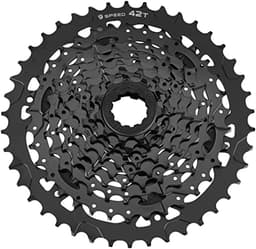
microSHIFT ADVENT Cassette, 9-Speed 11-42t
The cheap fix for a 9-speed bike whose bottom gear is too tall: 11-42t, about $37, and a 42t sprocket your derailleur has to be able to wrap.
$38.50 · View on AmazonPrice as of October 21, 2026. #ad How we’re funded
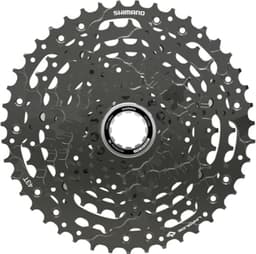
Shimano CUES CS-LG400-10 Cassette (11-48t)
The widest range here at 11-48t, with Shimano's durability claim — and compatible exclusively with LINKGLIDE shifting, which most first bikes do not have.
$78.32 · View on AmazonPrice as of October 21, 2026. #ad How we’re funded
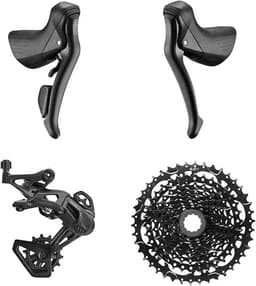
microSHIFT Sword Black 1x9 Groupset
The whole drop-bar drivetrain in one box, including an 11-42t cassette. A repair decision for a failed shifter rather than a climbing upgrade.
$219.99 · View on AmazonPrice as of October 21, 2026. #ad How we’re funded
We have not ridden or tested these — every specification comes from the manufacturer or the retailer listing, dated. Here is exactly what we do instead.
1x or 2x, for a hilly place
Two chainrings give a lower bottom gear for the same cassette, because the small ring does half the work: 34 front with 34 rear is 27.0 gear inches, while a 1x bike needs a 40-tooth ring and a 48-tooth sprocket to beat it. That is why cheap gravel bikes with 1x drivetrains often climb worse than cheap road bikes with 2x, despite sounding more modern.
The trade is simplicity and chain security, which is a real benefit on rough ground. The full comparison is here, and if you are still choosing a bike rather than modifying one, the groupsets explainer covers which tiers come with which ranges.
The things that are not gearing
Before spending money: a bike that climbs badly is sometimes a bike with soft tires, a dragging brake or a chain that has not been lubricated since it was assembled. All three are free to check and all three are more common than a genuinely wrong gear ratio. Pressure, brake rub and a clean chain are the ten-minute version of this page.
And if you are shopping rather than upgrading, gearing is a spec you can read before you buy. The bikes on our under-$1,000 gravel page and the under-$1,000 road page publish their tooth counts unevenly — where a listing gives them, the product’s own spec table on this site records them, and where it does not, it says “not published” rather than guessing.
Questions people actually ask
What gearing do I need for steep hills?
Aim for a lowest gear under about 30 gear inches, and under about 25 if the hills near you are genuinely steep or long. A 50/34 compact with an 11-28 cassette gives about 32.8 gear inches; the same chainset with an 11-34 cassette gives 27.0. The arithmetic is (chainring teeth divided by sprocket teeth) times wheel diameter in inches, so you can check your own bike in a minute.
What is the easiest gear on a road bike?
The smallest front chainring combined with the largest rear sprocket. On most budget road bikes that is a 34-tooth ring and a 28-tooth sprocket — which is a higher gear than many riders need for a steep climb, and the reason the cassette is the usual upgrade.
Is a bigger cassette worth it for climbing?
It is the cheapest change that genuinely fixes a bottom gear that is too tall. Going from an 11-28 to an 11-34 at the back drops your lowest gear from about 32.8 to 27.0 gear inches — a meaningful difference on a steep climb. The catch is compatibility: the derailleur has to be able to wrap the biggest sprocket.
How do I know if a cassette will fit my bike?
Three checks. Speed count must match your shifter (a 9-speed shifter needs a 9-speed cassette). The rear derailleur must be rated for the largest sprocket — microSHIFT's own listing for the 11-42 cassette does not publish the capacity needed, so check your derailleur's rating. And a wider cassette usually needs a longer chain, which people forget to order.
Is 1x or 2x better for hills?
2x gives you a lower bottom gear for the same cassette, because the small chainring does half the work. A 1x setup needs a very wide cassette — an 11-48, say — to reach the same low gear, and that widens the jumps between gears. For hilly riding on a budget bike, a wider cassette on an existing 2x drivetrain is usually the cheaper route.
Do I need a new chain when I fit a bigger cassette?
Usually yes, and often a longer one. A wider cassette needs more chain to wrap the big sprocket, and fitting a new cassette to a worn chain makes the new cassette skip. If the chain is near its wear limit anyway, replace both together.
Will lower gearing make me slower?
Only at the top end, which on a first bike you rarely use. Swapping the cassette for a wider range keeps the same small sprocket at the fast end, so your top gear is unchanged — what changes is that the gaps between gears get bigger. You trade some fine control for a climbing gear you will actually use.
Sources
Specifications come from the manufacturer or the retailer listing, dated. Where a figure is not published, we say so rather than estimating it.
- Shimano — A guide to 1x and 2x gearing setups for gravel — Manufacturer explanation of one-chainring versus two-chainring drivetrains (accessed July 23, 2026)
- microSHIFT — Sword gravel group — The manufacturer's own page for the drop-bar gravel group: offered in 1x10 and 2x10, cassette ranges published as 11-48T for the 1x and 11-38T for the 2x, described as a fully mechanical design that is easy to service and adjust, with a fully replaceable derailleur cage held by three screws (accessed September 15, 2026)
- Shimano — CUES component range — Shimano's own CUES range page. Verified by domain-restricted search rather than fetch, because bike.shimano.com returns 403 to non-browser clients: CUES U6000 is the benchmark series at 10-speed (also offered in 11-speed) and U4000 is the entry-level 9-speed series, and the range is built on LINKGLIDE, which Shimano state gives up to three times the durability of HG when used with an e-bike (accessed September 15, 2026)
- Park Tool — Rear derailleur adjustment — The published indexing procedure: H-limit, barrel adjuster direction, indexing across the cassette, L-limit, then B-screw, with the symptom-to-fix table (accessed August 13, 2026)
- Park Tool — When to replace a worn chain — The 0.5% / 0.75% / 1.0% chain-wear replacement thresholds and the ruler method for measuring them (accessed August 11, 2026)
Read next
1x vs 2x Gearing
One chainring or two, and which gives a usable low gear on a budget bike.
Read the comparisonBike Groupsets Explained
What Claris, Sora and Tiagra actually mean, and which parts a cassette has to agree with.
Read the explainerBest Budget Bike Upgrades
Where a cassette swap sits against tires, pedals and contact points for improvement per dollar.
See the upgradesHow to Index Bike Gears
Setting the new cassette up so it shifts cleanly, which is the half of the job nobody budgets for.
Read the how-to