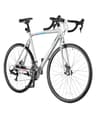
What you are actually giving up at this price
Not the frame. Aluminum tubes welded into a road bike shape are a solved problem and every bike here has one, or something close to it. What you give up is everything bolted to it.
- Named components. Look at the spec tables above. Only the HILAND still leaves its drivetrain brand unnamed; the other three now name one, which is a genuine improvement on this band since we first checked. An unnamed derailleur is the problem, because it means a worn-out one becomes a “we cannot get that part” conversation rather than a $40 fix. A bike that doesname a budget brand is telling you something useful — what L-TWOO, microSHIFT and Shimano CUES actually are covers how much that name is worth, and how long each brand’s spares take to arrive.
- Published frame sizes. The HILAND and the Eurobike publish real centimeter measurements — S 49cm, M 53cm and L 57cm on the HILAND, 49cm and 54cm on the Eurobike. The AVASTA gives a frame size in inches and the VEVOR publishes none at all, and a size you cannot check against a size chart is the most expensive omission on the list, because size is the one thing you cannot fix afterward.
- Sealed bearings. Rarely stated at this price, and usually absent. Unsealed bearings let in water and grit, which is why cheap bikes develop creaks and stiff steering after a wet winter.
- Weight. None of these publish one. Expect several pounds more than a $700 bike, most of it in the wheels, where it matters most for how the bike feels to accelerate.
What you are NOT giving up
Worth saying, because the internet is unkind about cheap bikes and some of it is snobbery rather than information.
- Safety.A correctly assembled cheap bike is a safe bike. The risk is a bad build, not a cheap frame — which is exactly why the shop check below is not optional.
- The experience. Riding a $330 bike on a good road on a good morning is essentially the same experience as riding a $900 one. The difference shows up over hours and over years, not in the first ten minutes.
- Fitness. The bike is not why you are or are not fast.
The one thing you must not skip
Pay a shop $75 to $150 to check the build. On a $300 bike that feels like a lot of money proportionally, and it is the most important money in the entire purchase.
These bikes arrive partly assembled in a box, and the parts most often wrong out of the box are the brakes and the headset bolts — which are precisely the parts where wrong is dangerous rather than annoying. Every bike shop does this and none of them will judge you for where you bought it.
Should you buy a hybrid instead?
Genuinely worth considering, and it is why the AVASTA is on this list. If your realistic riding is commuting, errands and towpaths — rides under an hour — a flat-bar hybrid at this price is usually a better bike than a drop-bar bike at the same price. Upright position, better visibility in traffic, and the budget goes further because the frame is simpler.
The moment that flips is distance. A flat bar gives you one hand position; drop bars give you three or four, which is what decides whether hour two is comfortable. Under an hour, hybrid. Over two hours, drop bars, clearly.
The case for waiting
We will say this plainly because nobody else does. The gap between a $330 bike and a $600 bike is the largest single jump in quality anywhere on the price ladder — it is the step where the gears get a name, the sizing gets published, and a shop can service what you own.
If you can save for two more months, buy the Tommaso Imola instead. You will keep it for years rather than replacing it in one, and the total cost of that path is lower.
If you cannot — and plenty of people genuinely cannot — buy from this list without embarrassment, get it checked by a shop, and go riding. A bike you are riding beats a better bike you are still saving for.