When to Replace a Bike Chain
A chain is the cheap part that protects the expensive parts. Measure it, replace it on time, and one purchase turns into three when you do not.
How this is funded: we earn a commission if you buy through our links, at no extra cost to you. It never changes which bike we recommend, and we will tell you plainly when we would skip one. Full disclosure.
A chain is designed to wear out. That is not a defect — it is the cheapest part of the drivetrain doing its job, which is absorbing wear that would otherwise land on the cassette and chainrings.
The whole discipline is: measure it every month or so, and replace it at the published limit. Do that and one part wears out. Ignore it and three do.
What “chain stretch” actually is
A new chain has a pin every half inch, precisely. Grit gets between the pin and the roller and grinds material away, so the spacing grows. Once the chain’s spacing no longer matches the tooth spacing, the load stops being shared evenly across several teeth and starts concentrating on one or two — which is what wears the sprockets into a hooked shape.
That is why the deadline matters. Before the limit, only the chain is being damaged. After it, everything the chain touches is.
The two ways to measure
A chain checker (30 seconds)
A small gauge that drops into the chain. One end reads 0.5% wear and the other 0.75%. If the tool drops fully into the chain at a given mark, you have reached that wear level.
Park Tool publish the thresholds their tools are built around: 0.5% for 11 and 12-speed chains, 0.75% for 10-speed and fewer. Modern narrow chains have less material to lose, which is why the tolerance is tighter.
A steel ruler (free)
- Shift onto the big chainring so the chain is under some tension, and lay a steel ruler along the top run.
- Put the zero mark exactly on the center of one chain pin.
- Look at the pin nearest the 12-inch mark. On a new chain it lands exactly on 12 inches, because chain links are half an inch and 24 links is a foot.
- About 1/16 inch past is roughly 0.5% wear. About 1/8 inch past is roughly 1%, and at that point assume the cassette has gone too.
The ruler method is less convenient and perfectly adequate. The checker exists because nobody actually does the ruler method every month.
What it costs to get this wrong
In order, as wear progresses:
- At the limit: a chain. The cheapest drivetrain part there is.
- Past 1%: a chain and a cassette, because the new chain will skip on sprockets that have worn to the old chain’s spacing.
- Well past 1%: chain, cassette and chainrings, which on an entry-level bike can approach a meaningful fraction of what the bike cost.
The test for whether you have already crossed the line: fit the new chain, put the bike in a middle gear, stand up and pedal hard. If the chain jumps forward under load, the cassette needs replacing with it.
What this needs
One tool that turns this into a thirty-second monthly check, and the two consumables that decide how long the next chain lasts.
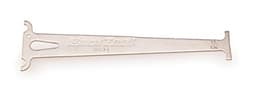
Park Tool CC-3.2 Chain Checker
Drops into the chain and reads both wear thresholds. Cheaper than a cassette by a wide margin, and it is the tool the published limits were written for.
$12.85 · View on AmazonPrice as of October 20, 2026. #ad How we’re funded
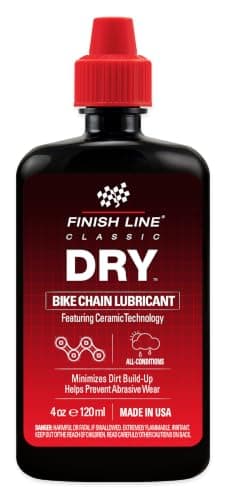
Finish Line Dry Ceramic Chain Lubricant
A clean, lubed chain wears far slower than a dry gritty one. Dry-film lube for dry roads and dusty gravel.
$11.99 · View on AmazonPrice as of October 20, 2026. #ad How we’re funded
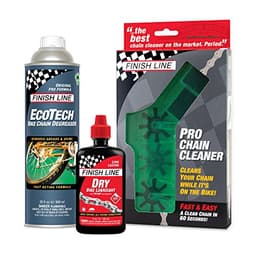
Finish Line Pro Chain Cleaner Kit
Scrubber, degreaser and lube in one box - the grit between the pins is what wears the chain, so removing it is the actual job.
We have not ridden or tested these — every specification comes from the manufacturer or the retailer listing, dated. Here is exactly what we do instead.
How to make chains last longer
- Keep it clean. Grit is the mechanism of wear. Wiping the chain with a rag after a dusty or wet ride takes a minute and is the highest-value habit here.
- Lube it properly and wipe the outside. Lube belongs inside the rollers. The film left on the outer plates only collects dirt — the lube page covers the technique.
- Do not cross-chain habitually. Running big ring to biggest sprocket puts the chain at a severe angle and wears it faster; the crankset guide explains why.
- Do not degrease it to bare metal and then ride it dry. A spotless, unlubricated chain wears faster than a slightly dirty lubricated one.
Fitting a new one
A chain needs to be the correct speed count for your drivetrain — an 11-speed chain is narrower than a 9-speed one — and it needs cutting to length, which means a chain tool or a shop visit. The safe method is to match the new chain link for link against the old one before cutting.
Most modern chains join with a quick link, which needs no tool to close and a pair of pliers to open. If your multitool has a chain breaker, you have everything you need for the roadside version of this job too.
And while the chain is off, it is the ideal moment to clean the cassette properly — it is never more accessible than it is right then.
The chain is the shortest-lived part on the bike, which makes it the first entry in a longer list: how long a bike lasts sets the published chain thresholds alongside the limits for tires, pads and the parts nobody publishes an interval for at all.
Questions people actually ask
How do I know when my bike chain needs replacing?
Measure it rather than guessing. A chain checker is a small tool that drops into the chain and tells you how far it has worn, and Park Tool publish the thresholds their tools are built around. As a chain wears, the distance between its pins grows - which is why it is loosely called stretch - and past a certain point it starts wearing the sprockets to match its new spacing.
What does 0.5% and 0.75% chain wear mean?
It is how far the chain has elongated compared with a new one. Park Tool's published guidance is that 0.5% is the replacement point for 11 and 12-speed drivetrains, and 0.75% for 10-speed and fewer. Replace at those marks and the cassette usually survives. Ride past 1% and you are generally buying a cassette as well, and often chainrings too.
How long does a bike chain last?
There is no honest mileage figure, because it depends enormously on how clean you keep it, how much you cross-chain, your weight and your weather. A well-maintained chain on a dry-weather bike can last several thousand miles; a neglected chain in winter grit can be finished in under a thousand. This is exactly why the answer is to measure rather than to count miles.
Can I measure chain wear with a ruler?
Yes, and it is the free method. Bike chain links are half an inch, so twelve full links measure exactly 12 inches when new, pin center to pin center. Lay a steel ruler along the chain with the zero mark on a pin center: if the twelfth pin sits about 1/16 inch past the 12-inch mark, the chain is around 0.5% worn; 1/8 inch past is roughly 1%, and by then the damage is done.
What happens if I do not replace a worn chain?
The worn chain reshapes the teeth on your cassette and chainrings to match its longer spacing. Fit a new chain after that and it skips under load on the worn sprockets, so you end up replacing the cassette too - and if it has gone far enough, the chainrings. A chain is the cheapest part of the drivetrain and replacing it on time is what keeps the other two alive.
Should I replace the cassette with the chain?
Not automatically. If you have been replacing chains at the wear limit, the cassette usually outlasts two or three chains. Replace both when a new chain skips under load on the old cassette - put the new chain on, stand up and pedal hard in the middle sprockets, and if it jumps forward, the cassette is worn to the old chain's spacing.
Sources
Specifications come from the manufacturer or the retailer listing, dated. Where a figure is not published, we say so rather than estimating it.
- Park Tool — When to replace a worn chain — The 0.5% / 0.75% / 1.0% chain-wear replacement thresholds and the ruler method for measuring them (accessed August 11, 2026)
- Park Tool — How to clean and lubricate a chain — Manufacturer procedure for degreasing, drying and re-lubricating a bicycle chain (accessed August 11, 2026)
- Shimano — Component product list — Shimano's own component lineup, from which the road groupset hierarchy is read (accessed July 23, 2026)
Read next
How to Clean a Bike Chain
The job that decides how long the next chain lasts.
Read the guideBest Bike Chain Lube
Wet, dry and wax, plus the cleaning kits, with live prices.
See the picksBest Bike Tool Kits
The chain checker and chain tool, and what else is worth owning.
See the tool picksBike Maintenance for Beginners
Where chain checks sit in the wider routine.
Read the guide