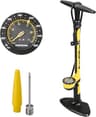
The most under-rated purchase in cycling. Six pumps with live prices, the valve trap that defeats beginners, and when you actually need a charger pump.
Buy the BV ergonomic floor pump. The automatically reversible head takes both valve types without you dismantling anything, which is the exact point where most beginners give up and take the bike to a shop for something that should take ninety seconds.
A floor pump is the second thing to buy after a helmet, ahead of shorts, ahead of everything. Road and gravel tires lose pressure through the tube wall every few days whether you ride or not. Riding on soft tires is slow, harsh, and the single most common cause of punctures — a soft tire lets the rim pinch the tube against an edge, which is why it is called a pinch flat.
How this is funded: we earn a commission if you buy through our links, at no extra cost to you. It never changes which bike we recommend, and we will tell you plainly when we would skip one. Full disclosure.
Quick picks
Ranked on published specs, what the listing does and does not tell you, and who each one actually suits. Select a row to jump to the full write-up. We have not ridden these — here is exactly what we do instead.
#
Bike or gear
Best for
Price
1
BV Ergonomic Floor Pump
The reversible smart head is the feature that matters and the one beginners do not know to look for: it takes both valve types without you dismantling and reassembling anything, which is where most people give up on pumping their own tires.
The floor pump that shops use. A steel barrel and a 3-inch gauge you can actually read from standing height — this is a buy-once item that will outlast several bikes.
A steel-barrel floor pump for the price of a couple of inner tubes. Steel rather than plastic is the single spec that decides whether a cheap pump is still working in five years.
The single most useful thing you can buy after the bike. Road and gravel tires lose pressure every few days, and a floor pump with a gauge is the difference between riding at the right pressure and guessing.
A charger pump — it builds pressure in a chamber and releases it in one blast, which is how a tubeless tire bead gets seated without a compressor. If you have fought a tubeless setup with a normal pump, this is the tool you were missing.
A pump the size of a phone that inflates to a set pressure and stops on its own. Roadside inflation with a mini pump is genuinely miserable work, and this removes it for the price of a mid-range mini pump.
The reversible smart head is the feature that matters and the one beginners do not know to look for: it takes both valve types without you dismantling and reassembling anything, which is where most people give up on pumping their own tires.
Who it is for: A first floor pump, especially if you own more than one bike.
What is good
+Automatically reversible head fits both Presta and Schrader without swapping parts
+160 PSI rating covers road, gravel and every other tire you own
+Gauge on the base, which is the whole point of a floor pump over a hand pump
+Stable footprint that does not tip when you are pushing hard
What you give up
−Gauges at this price are approximate — treat readings as within a few PSI
−Plastic head components are the usual long-term failure point
−No published hose length
Skip this if. Skip this if you are setting up tubeless tires. Seating a tubeless bead needs a sudden high-volume blast, and a standard floor pump usually cannot deliver it — you want a charger pump or a compressor.
Published specifications for the BV Ergonomic Floor Pump
Max pressure
160 PSI
Valve compatibility
Presta and Schrader, auto-reversible head
Gauge
Yes
Tubeless charger
No
Hose length
Not published
Specifications read from the retailer listing on August 11, 2026. “Not published” means the listing does not state that figure — we do not estimate it.
#2Best built
Topeak JoeBlow Sport III
The floor pump that shops use. A steel barrel and a 3-inch gauge you can actually read from standing height — this is a buy-once item that will outlast several bikes.
Who it is for: A pump you will still be using in ten years.
What is good
+Steel barrel rather than plastic — this is the part that fails on cheap pumps
+3-inch analog gauge is readable from standing, unlike small gauges at your feet
+TwinHead DX5 handles Presta, Schrader and Dunlop valves without swapping parts
+Long hose means you can reach the valve without wrestling the bike
What you give up
−Roughly double the price of the TOOLITIN
−Heavier and bulkier to store
−No published gauge accuracy tolerance
Skip this if. Skip this if you are buying your first bike and counting every dollar. The TOOLITIN does the same job today; this one just does it for longer, and that is a decision you can defer.
Published specifications for the Topeak JoeBlow Sport III
Maximum pressure
160 PSI
Valve types
Presta, Schrader and Dunlop
Gauge
3-inch analog
Barrel
Steel
Gauge accuracy
Not published
Specifications read from the retailer listing on July 23, 2026. “Not published” means the listing does not state that figure — we do not estimate it.
#3Best on a tight budget
BV Steel Floor Pump
A steel-barrel floor pump for the price of a couple of inner tubes. Steel rather than plastic is the single spec that decides whether a cheap pump is still working in five years.
Who it is for: The cheapest pump we would actually tell someone to buy.
What is good
+Steel barrel, which is what separates a pump that lasts from one that splits
+160 PSI rating with a smart valve head for both valve types
+Gauge included at this price
+Two barrel size options for different effort-per-stroke preferences
What you give up
−Base is lighter than the premium pumps and can shift under hard strokes
−Gauge accuracy at this price is indicative rather than precise
−No published hose length
Skip this if. Skip this if you already own any working floor pump. The upgrade from a functional cheap pump to a better cheap pump is the least valuable thirty dollars you can spend on a first setup.
Published specifications for the BV Steel Floor Pump
Max pressure
160 PSI
Barrel
Steel
Valve compatibility
Presta and Schrader, smart head
Gauge
Yes
Hose length
Not published
Specifications read from the retailer listing on August 11, 2026. “Not published” means the listing does not state that figure — we do not estimate it.
#4Best adapter storage
TOOLITIN Floor Pump with Gauge
The single most useful thing you can buy after the bike. Road and gravel tires lose pressure every few days, and a floor pump with a gauge is the difference between riding at the right pressure and guessing.
Who it is for: Every drop-bar bike owner, without exception.
What is good
+Built-in gauge, so you set pressure rather than squeezing the tire and hoping
+Handles the narrow Presta valve most road and gravel bikes use, and the car-style Schrader valve
+The three adapters live in a box in the handle, which is the only reliable way not to lose them
+One-piece metal barrel and a wide composite base, so it does not split or skate across the floor
What you give up
−Gauge accuracy on budget pumps drifts over time, and no tolerance is published
−The listing does not say whether the head is auto-reversible, so assume you may have to swap the internals to change valve type
−No published hose length
Skip this if. Skip this only if you already own a floor pump. There is no version of owning a drop-bar bike where you do not need one — a mini pump is for emergencies on the road, not for setting pressure at home.
Published specifications for the TOOLITIN Floor Pump with Gauge
Maximum pressure
160 PSI / 11 bar
Valve types
Presta and Schrader
Gauge
Yes
Barrel
One-piece metal
Extras
Three adapters, stored in the handle
Head type
Not published
Gauge accuracy
Not published
Specifications read from the retailer listing on August 15, 2026. “Not published” means the listing does not state that figure — we do not estimate it.
#5Best for tubeless
Feedback Sports Pneuma CC
A charger pump — it builds pressure in a chamber and releases it in one blast, which is how a tubeless tire bead gets seated without a compressor. If you have fought a tubeless setup with a normal pump, this is the tool you were missing.
Who it is for: Setting up and re-seating tubeless tires at home.
What is good
+Charger chamber delivers the sudden high-volume blast tubeless beads need
+Works as an ordinary floor pump the rest of the time
+Compact form factor for a charger pump, which are usually enormous
+Feedback Sports build their tools to be serviced rather than replaced
What you give up
−By far the most expensive pump here, and the only one over $100
−Completely unnecessary if you run inner tubes
−More moving parts than a plain floor pump, so more things to eventually service
Skip this if. Skip this if your bike came with inner tubes and you have no plans to change that. Most first drop-bar bikes ship tubed, and for a tubed setup this is an expensive pump that does nothing a $24 one does not.
Published specifications for the Feedback Sports Pneuma CC
Type
Charger / tubeless floor pump
Tubeless charger
Yes
Doubles as standard pump
Yes
Max pressure
Not published
Gauge
Not published
Specifications read from the retailer listing on August 11, 2026. “Not published” means the listing does not state that figure — we do not estimate it.
#6Best portable
CYCPLUS Portable Electric Inflator
A pump the size of a phone that inflates to a set pressure and stops on its own. Roadside inflation with a mini pump is genuinely miserable work, and this removes it for the price of a mid-range mini pump.
Who it is for: Roadside repairs, and anyone who dislikes pumping to 80 PSI by hand.
What is good
+Auto shut-off at a target pressure, so you get the number you asked for
+150 PSI rating, well beyond what any road or gravel tire needs
+Small enough to live in a jersey pocket or saddle bag
+Removes the worst part of fixing a flat away from home
What you give up
−It has a battery, so it can be flat exactly when you need it
−Slower than CO2 for a race-day repair
−More failure modes than a hand pump, which has essentially none
Skip this if. Skip this if you want a tool that cannot fail. A hand pump has no battery, no electronics and no charge state, and on a long remote ride that reliability is worth more than the convenience.
Published specifications for the CYCPLUS Portable Electric Inflator
Type
Electric portable inflator
Max pressure
150 PSI
Auto shut-off
Yes
Valve compatibility
Presta and Schrader
Battery runtime
Not published
Specifications read from the retailer listing on August 11, 2026. “Not published” means the listing does not state that figure — we do not estimate it.
The valve trap, which defeats more beginners than anything else
Here is the sequence that catches everyone, in order, because it is worth knowing before you own a pump rather than after:
Unscrew the little nut on top of the valve until it stops. It does not come off. If you skip this, no air goes in and the pump appears broken.
Press the pump head straight on and flip the lever to lock it. Straight on — Presta valve stems are thin brass and they bend if you lever the pump sideways.
Pump. The gauge will read nothing for the first few strokes while the hose pressurizes. That is normal.
Flip the lever off and pull straight down. A short hiss is the hose emptying, not your tire.
Screw the little nut back down and, if there is one, put the dust cap back.
The whole thing is easier with a smart or auto-reversible head, which detects the valve type and seals against it without you swapping any internal parts. If the two valve types are new to you, Presta versus Schrader explains which one your bike has and why it decides the pump. Older pumps require you to unscrew the head, remove a rubber grommet, turn it around and reassemble — in the dark, at the roadside, with cold hands. Most of the pumps on this page state that they avoid it, and it is the first feature we look for — where a listing does not say, our spec table says so rather than assuming.
Why a floor pump and not a mini pump
You need both, eventually, and the floor pump first. A mini pump is a get-home tool: it moves a small amount of air per stroke and getting a road tire to 80 PSI with one is several hundred strokes of genuinely unpleasant work. A floor pump moves a large volume per stroke, uses your body weight rather than your arms, and has a gauge so you know what you actually achieved.
Which mini pump, and whether a CO2 inflator is a better answer in winter, is its own decision — our mini pump and inflator roundup judges six of them on the valve head and the hose rather than the pressure number.
The gauge is the part people underrate. Without one you are guessing, and tire pressure is a free upgrade that almost every beginner is getting wrong in the same direction — too hard on gravel, too soft on the road.
What actually differs between pumps
Barrel material. Steel or aluminum lasts; plastic splits. This is the spec that decides whether a cheap pump is still working in five years.
Head type. Auto-reversible or smart heads, as above. Non negotiable.
Gauge position and size. A gauge at the base is easier to read mid-stroke than one on the handle. Bigger dials are easier to read accurately.
Base stability. A wide, heavy base does not skate across the garage floor when you push hard at 70 PSI.
Hose length. Rarely published, and short hoses make you move the whole pump to reach a valve at the top of the wheel.
Max pressure. 160 PSI on every pump here, which is far above anything a road or gravel tire needs. Ignore this number; it is marketing.
Gauge accuracy, honestly
Analog gauges on pumps under about $50 are approximate. Treat a reading as ±5 PSI or so. That is fine for a road tire at 80 PSI and it matters more on a wide gravel tire at 30 PSI, where 5 PSI is a noticeable share of the total.
The practical answer: use the same pump every time. A consistent gauge that is slightly wrong is more useful than two accurate gauges that disagree, because what you are really doing is learning what a number feels like on your bike.
When you need a charger pump
Only if you run tubeless tires. Seating a tubeless bead requires a sudden high-volume blast of air to pop the tire against the rim before the air escapes, and a normal floor pump cannot usually deliver it no matter how fast you pump. A charger pump builds pressure in a separate chamber and releases it all at once.
Most first drop-bar bikes ship with inner tubes, so most readers can ignore this entirely. If you are weighing the switch, our tubeless versus tubes comparison covers what you are actually signing up for.
How often to pump
Before every ride is the honest answer, and once a week is the realistic minimum. Narrow high-pressure road tires lose pressure fastest — noticeably within a few days. Wide low-pressure gravel tires hold on longer. The check takes ten seconds once the pump lives somewhere convenient, which is the actual reason to own a floor pump rather than borrowing one.
What we would spend
About $32 on the BV ergonomic pump. If you want one that will outlive several bikes, the Topeak JoeBlow Sport III at around $45 is the standard answer and has been for twenty years.
A floor pump is also one of the few pieces of cycling equipment that makes a genuinely good gift, because it needs no size and fits every bike in the garage — it is one of the picks on our list for dad.
We have not ridden these bikes. Every site in this category says it tested twenty of them. We have not tested any, and we say so. What we did instead: read the manufacturer listings and manuals, compiled the published specs, worked out the real out-the-door cost, and checked live availability and price. Here is exactly how that works.
Questions people actually ask
Do I need a floor pump if I have a mini pump?+
Yes. A mini pump is a get-home tool — it moves very little air per stroke, and reaching 80 PSI with one takes several hundred strokes. A floor pump uses your body weight, moves far more air per stroke, and has a gauge so you know what pressure you actually achieved. Buy the floor pump first and keep the mini pump on the bike.
How do I pump up a Presta valve?+
Unscrew the small nut on top of the valve until it stops — it does not come off, and skipping this is why the pump seems broken. Press the head on straight, flip the lever to lock, and pump. The gauge reads nothing for the first few strokes while the hose pressurizes. Unlock, pull straight off, and screw the nut back down.
How often should I pump up my bike tires?+
Before every ride ideally, once a week at minimum. Bicycle tires lose pressure through the tube wall whether you ride or not, and narrow high-pressure road tires lose it fastest — noticeably within a few days. Riding on soft tires is slow, harsh, and the most common cause of pinch punctures.
Are cheap bike pump gauges accurate?+
Approximately. Treat a reading from a pump under about $50 as within roughly 5 PSI. That is fine for a road tire at 80 PSI and matters more on a wide gravel tire at 30 PSI. The practical fix is to use the same pump every time — a consistent gauge that is slightly off is more useful than two that disagree.
What happened to the Vibrelli floor pump?+
It used to be on this page and Amazon now shows it as currently unavailable, so we have taken it off rather than leave a buy link that goes nowhere. Its selling point was the included puncture repair kit; nothing we could verify as in stock matches that exactly, so the slot now goes to the TOOLITIN, which keeps its adapters in a box in the handle. If you want the repair kit, buy a patch kit separately — it costs a few dollars.
What is a tubeless charger pump?+
A floor pump with a separate pressure chamber that releases air in one sudden blast, which is what a tubeless tire bead needs to pop into place against the rim. A standard floor pump usually cannot do it however fast you pump. You only need one if you run tubeless — most first drop-bar bikes ship with inner tubes.
What pressure should I run in my tires?+
It depends on tire width, your weight and the surface, and the number printed on the sidewall is a maximum rather than a recommendation. Wide gravel tires want far less than most beginners assume. Our gravel tire pressure guide works through how to find yours rather than giving one number.
Sources
Specifications come from the manufacturer or the retailer listing, dated. Where a figure is not published, we say so rather than estimating it.