Is a Wheel Upgrade Worth It?
On a beginner bike, usually not — the tires do most of what people hope the wheels will do. But unlike the groupset, there are three cases where new wheels are the right buy. Here is how to tell which case you are in, and the five compatibility checks to run before you spend anything.
How this is funded: we earn a commission if you buy through our links, at no extra cost to you. It never changes which bike we recommend, and we will tell you plainly when we would skip one. Full disclosure.
On a beginner road or gravel bike, usually not — but this is a closer call than the groupset question, and for a better reason. A groupset upgrade buys you a crisper shift and nothing else. New wheels can buy you a genuine capability your current wheels do not have. The trouble is that the capability most people are actually paying for is one the tires already provide, far cheaper.
So this page does two things. First it separates the three cases where new wheels are the right purchase from the much larger case where they are not. Then — because a wheel is the one upgrade where buying the wrong thing means a part that physically will not go into your frame — it walks the five compatibility checks that decide what you are even allowed to buy.
Start here: the attribution problem
Ask a rider what they want from new wheels and the answer is almost always some combination of: rolls faster, grips better, feels less harsh, punctures less. Every single one of those is a property of the tire, not the wheel. The wheel is a rim, some spokes and a hub. It sets what tire you can fit and how reliably the whole thing stays round. It does not grip the road.
This is not a rhetorical point. It is testable, and it costs almost nothing to test: change the tires first. If the bike comes alive, the wheels were never the problem and you have just saved several hundred dollars. If it still feels dead afterwards, now you have real evidence and a much better question to ask.
The weight argument, and why you cannot check it
The usual case for a wheel upgrade is weight, and specifically rotating weight. Here is the problem with it, from the actual published numbers.
Mavic publish 1,840 g per pair for their entry-level alloy road wheelset — 845 g front, 995 g rear. Vision publish 1,900 g for their entry-level alloy disc wheelset, and 1,920 g for the wider-rimmed gravel version of the same wheel. Those are the two upgrade candidates on this page whose makers publish a weight at all, and they are within about three percent of each other.
Now the number you would need to make a decision: what do your current wheels weigh?On a budget drop-bar bike, almost certainly nothing published anywhere. Across the bikes in this site’s registry, most listings publish no weight for the complete bike, let alone a figure for the wheels alone. So the saving is unknowable before purchase. You would be spending a large share of what the bike cost to subtract an amount nobody will tell you.
We are not going to invent that figure to make the maths look better. The honest position is that if weight is your reason, you cannot verify your reason, and an upgrade you cannot verify is a guess with a receipt.
The three times it genuinely is worth it
- A wheel has failed past truing. This is the common one, and it is not really an upgrade — it is a repair you may as well do well. Park Tool work a trued wheel to 0.5 mm or less of lateral wobble and 1 mm or less of radial hop, and they name three conditions where that is not achievable: the rim metal itself is bent, corrosion has seized the nipple threads, or spokes keep breaking. Their working rule for the last one is blunt and useful — three broken spokes equals one new wheel. Short of those, a wobble is a bike-shop adjustment, not a purchase.
- You want to run tubeless and your rims cannot. This is the strongest case on the page, because it is the only one where new wheels buy a capability rather than a sensation. Park Tool are unambiguous that a rim not designed to run without a tube is not a candidate for it, and no sealant or tape trick changes that. Whether you actually want tubeless is a separate question worth answering first — on a road bike at road pressures the case is much weaker than on gravel.
- The wheels will move to your next bike. The upgrade hub makes this distinction the central one: spend freely on what you keep, reluctantly on what you leave behind. Wheels are usually in the second category, because the standards move. But if you have settled on disc brakes and thru-axles and you know the next frame will use them too, a good wheelset is one of the few large purchases that genuinely transfers.
Notice that none of the three is “to go faster”. If speed is the goal, the money belongs in tires and then in getting the pressure right, which is free.
The five compatibility checks, before you spend anything
This section is the real reason this page exists. With most upgrades, buying the wrong one means a part you do not love. With wheels it means a part that will not go into the frame. Work through these five in order and the shopping list writes itself.
1. Brake type — rim or disc
A rim-brake wheel has a machined braking surface on the outside of the rim and no mount for a rotor. A disc wheel has a rotor mount and no braking surface. They are different parts for different frames and nothing bridges them. Check this first because it eliminates more than half the market in one step, and because it is the mistake that cannot be returned-and-swapped quietly.
2. Axle standard — quick release or thru-axle
Park Tool describe both systems: the quick-release cam “puts tension on the shaft and pulls both the cam and the adjusting nut tight against the dropouts”, while a thru-axle passes through the hub into the frame, and some of them operate with a similar-looking lever. The resemblance is exactly what causes the error.
Road and gravel sizes have settled into two camps: quick release at 100 mm front and 130 mm rear, or thru-axle at 12 x 100 mm front and 12 x 142 mm rear. This matters enormously on budget bikes, because a lot of cheaper disc bikes are quick-release while most named-brand alloy disc wheelsets are thru-axle only. Vision say so on their own product page in as many words: not compatible with QR. If you have a quick-release disc bike, that single line rules out a lot of otherwise obvious choices.
3. Rotor mount — Center Lock or six-bolt
Disc wheels only. Center Lock uses a splined interface and a lockring; six-bolt uses six small bolts on a circular flange. Adapters exist in one direction, but the simple version is: if your rotors are six-bolt and the wheel is Center Lock, budget for new rotors too. A wheelset listing that does not state its rotor mount is a listing to ask about before ordering, not after.
4. Freehub body and speed count
This is the trap that catches careful shoppers, because the two versions look identical in photographs. Vision publish two reference codes for the same Team 30 Disc wheel — one for the Shimano 11-speed build, one for the SRAM XDR build — and the part number is the only way to tell them apart. When a retailer listing shows a part number, match it against the manufacturer’s own reference list. When it does not, treat the freehub as unconfirmed.
If you are not sure what your bike has, the groupset explainer names what to look for, and the Shimano and SRAM comparison covers which family you are in.
5. Internal rim width against the tire you want
The last check, and the one most listings invite you to get wrong. Park Tool’s published fit guidance is that tire width should land roughly one-and-a-half to two times the rim’s internal width. So a 17 mm internal rim — which is what both of the cheaper wheelsets here publish — is squarely a narrow-tire rim, whatever range the listing claims. Mavic publish a 23 mm to 52 mm range for their 17 mm rim; read the top of that as a structural ceiling, not a recommendation. Vision publish 23 mm internal on the gravel version of their wheel precisely because wider tires want a wider rim under them.
Trek, for their part, publish that race-geometry road frames typically clear tires only up to 28 mm while endurance frames go far wider — so the frame may cap you before the rim does. The tire width guide works through both limits, and 700c versus 650b covers the one wheel-size choice that is genuinely a decision rather than a constraint.
What this costs, roughly
No numbers here, because prices move and the live ones are on the buttons below. The brackets, though, are stable and they are the part that should inform the decision:
- A sound replacement pair from a company you have heard of sits at roughly what a decent pair of tires, a cassette and a chain would cost together. That is the cheapest honest entry point and it is a repair, not an upgrade.
- A named-brand alloy wheelset with a published weight and a tubeless-ready rim costs comfortably more — on a bike bought for a few hundred dollars, a large fraction of the whole bike.
- Carbon starts higher again and is where this gets genuinely upside-down. Carbon gravel and road wheelsets with real published weights are easy to find on the same marketplace, and we have deliberately registered none of them. Putting a carbon rim under a bike whose tires are the limiting factor is the wrong order of spending, and the spec sheet will not tell you that — so we are telling you here instead.
The ceiling the upgrade hub sets applies with full force to wheels: once the parts add up to more than about half what the bike cost, you are assembling a worse bike than you could have bought. A wheelset on its own can cross that line in a single purchase.
Four wheelsets, one per compatibility case
Not a ranking - a wheel either fits your frame or it does not, so these are sorted by the case they solve. Every ASIN was read from a live retailer response on October 3, 2026 and confirmed to carry a purchasable offer. Prices are live from the retailer; we do not store them, so what you see is current.
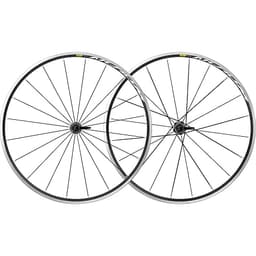
Mavic Aksium RB QR Wheelset
For a rim-brake bike with quick-release axles, which is most of the bikes this site recommends. It is here because Mavic publish the whole spec sheet - weight to the gram, rim dimensions, tire and pressure limits per width - so it is the least speculative wheel purchase available at this level.
$269.50 · View on AmazonPrice as of October 21, 2026. #ad How we’re funded
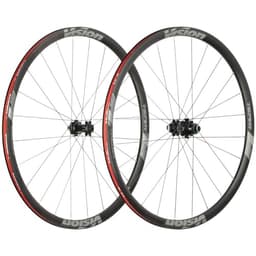
Vision Team 30 Disc Wheelset (Shimano 11-speed)
For a disc bike with thru-axles and a Shimano cassette. Built heavier on purpose at 24 spokes per wheel because disc braking loads a wheel differently, and the listing's part number matches Vision's own Shimano 11-speed reference - so the freehub is confirmed rather than assumed.
$368.47 · View on AmazonPrice as of October 21, 2026. #ad How we’re funded
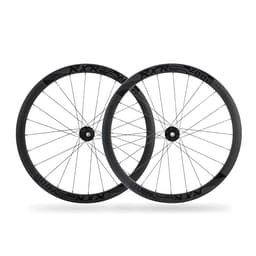
rningo D360 700c Disc Wheelset
For a quick-release disc bike, which is the awkward case the named brands have mostly abandoned. The listing states it converts between quick release and thru-axle and lets you choose the freehub at checkout. Bought for fitment, not for quality - read its cons before you commit.
$229.99 · View on AmazonPrice as of October 21, 2026. #ad How we’re funded
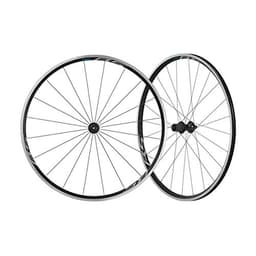
Shimano WH-RS100 Clincher Wheelset
For the case where a rim-brake wheel failed and you need a sound pair rather than a better one. Shimano's own entry-level road wheel, so bearings and freehub bodies stay orderable parts years from now. It is a replacement and nothing is published that suggests otherwise.
$190.00 · View on AmazonPrice as of October 21, 2026. #ad How we’re funded
We have not ridden or tested these — every specification comes from the manufacturer or the retailer listing, dated. Here is exactly what we do instead.
If one wheel failed, buy one wheel
Worth saying on its own, because it is the cheapest advice on this page. Front and rear wheels are sold separately, by every brand, including all four above. A front wheel that does not visually match the rear is a cosmetic issue and nothing more — no performance consequence, no safety consequence.
The rear is almost always the one that fails, because it carries most of the rider’s weight and all of the drive load, and because its spokes are shorter and more highly tensioned on the drive side. Buying a pair to fix one wheel is the single most common way this upgrade ends up costing twice what it needed to.
One thing to check before you order a single rear: your cassette has to come off the old wheel and onto the new one, which needs a lockring tool and a chain whip, or a shop visit. What a shop charges for small jobs has real published menus if you would rather hand it over.
Where the money should actually go
If you came here with a few hundred dollars and a feeling that the bike is slow, the wheels are the fourth or fifth thing to spend it on, not the first. The order that gets you the most per dollar is the one on the hub, and it starts well below this page.
The question underneath this one
As with the groupset question, most people asking about wheels are really asking whether to keep this bike or buy a better one. That is the more useful question and it usually has a cleaner answer, because a bike one real tier up arrives with better wheels already built, already matched to its own brake and axle standards, already warrantied as a complete bicycle.
If that is where you have landed, the sub-$1,000 road picks and the gravel bikes a tier above that are where the ladder goes next. And if the frame you own is genuinely worth keeping, the used market is where good wheels turn up at prices new ones never reach — just run the five checks above on them first, because a bargain wheelset that does not fit your frame is not a bargain.
Questions people actually ask
Is it worth upgrading the wheels on a cheap bike?
Usually not, for one reason: most of what riders hope new wheels will deliver - faster rolling, more grip, a less harsh ride - is actually delivered by the tires mounted on them, and tires cost a small fraction of what wheels cost. Change the tires first. If the bike still feels dead afterwards, the wheels were not the reason. There are three real exceptions, and they are all about capability or failure rather than speed.
Will new wheels make my bike faster?
Probably not in a way you can feel, and the honest problem is that you cannot even find out before you buy. The two named-brand alloy wheelsets we looked at publish pair weights of 1,840 g and 1,900 g. Almost no budget bike listing publishes what its stock wheels weigh, so there is no figure to subtract from. Buying a wheelset to save an unknown amount of weight is not a decision, it is a hope.
When should I replace a bike wheel instead of truing it?
Park Tool publish three conditions where truing will not bring a wheel back. The rim metal itself is bent, which shows up as the rim deviating toward the side whose spokes are loose rather than tight. Corrosion in the nipple threads, which they describe as making a wheel un-true-able. And repeated spoke failure, for which their working rule is three broken spokes equals one new wheel. Short of those, a wobble is usually an adjustment, not a purchase.
What do I need to check before buying a bike wheelset?
Five things, in this order: brake type (rim or disc - they are not interchangeable), axle standard (quick release or thru-axle), rotor mount if it is a disc wheel (Center Lock or six-bolt), freehub body and speed count (Shimano HG or SRAM XDR), and the rim's internal width against the tire width you want to run. Get any one of those wrong and the wheel either will not fit the frame or will not take your cassette.
Can I put a disc wheel on a rim-brake bike?
No. A rim-brake wheel has a machined braking surface on the side of the rim and no mount for a rotor; a disc wheel has a rotor mount and no braking surface. They are different parts for different frames, and no adapter bridges the two. This is also why a rim-brake wheelset cannot follow you to your next bike if that bike has disc brakes - worth knowing before you spend.
Do I need a tubeless-ready rim to run tubeless tires?
Yes. Park Tool are explicit that a rim which is not designed to run without a tube is not a candidate for it, and no amount of sealant or tape changes that. This is the single most legitimate reason to buy wheels on a budget bike: if the rims are not tubeless-ready, new wheels buy you a capability rather than a feeling, and that is a decision you can actually verify in advance.
Should I buy one wheel or a pair?
If one wheel failed, buy one wheel. Front and rear wheels are sold separately and a mismatched pair is a cosmetic issue, not a structural one. The rear is the one that usually goes, because it carries most of the rider's weight and all of the drive load. Buying a pair to fix one wheel is the most common way this upgrade gets twice as expensive as it needed to be.
Sources
Specifications come from the manufacturer or the retailer listing, dated. Where a figure is not published, we say so rather than estimating it.
- Park Tool — Wheel and rim truing — The published tolerances a trued wheel is worked to - aim for 0.5 mm or less of lateral deviation and 1 mm or less of radial deviation - and the three conditions under which a wheel cannot be trued back into service: the rim metal itself is bent (the giveaway is that the spokes on the side the rim deviates toward are the loose ones), corrosion in the nipple threads makes the wheel 'un-true-able', and repeated spoke failure, for which Park Tool give the working rule '3 broken spokes = 1 new wheel' (accessed October 3, 2026)
- Park Tool — Wheel removal and installation — The two axle systems described side by side: a quick release works by a cam that 'puts tension on the shaft and pulls both the cam and the adjusting nut tight against the dropouts', while a thru axle passes through the hub into the frame and some 'function similarly to quick-release axle - pull lever outward to disengage and turn to loosen'. The page does not treat them as interchangeable fitments (accessed October 3, 2026)
- Park Tool — Tire, wheel and inner tube fit standards — The ISO/ETRTO bead-seat table: 700c is 622 mm, 650B/27.5in is 584 mm, 650C is 571 mm, and none of them interchange. Also the rule of thumb that ISO tire width should be roughly 1.5 to 2 times the internal rim width (accessed August 18, 2026)
- Park Tool — Tubeless tire compatibility — Which rim and tire combinations are designed to run without a tube, and why a non-tubeless rim is not a candidate (accessed August 18, 2026)
- Mavic — Aksium wheelset — Manufacturer specification: 1,840 g per pair (845 g front, 995 g rear), S6000 aluminum rim 21 mm high with a 17 mm internal width, published as ETRTO 622x17C hooked; tire range from 23 mm at 8 bar / 115 psi to 52 mm at 5 bar / 72 psi; quick release only, front 9 x 100 mm and rear 9 x 130 mm; Shimano HG road freehub; 20 steel straight-pull spokes front and rear; tubetype tires only, not tubeless-ready (accessed October 3, 2026)
- Vision — Team 30 Disc wheelset — Manufacturer specification: 1,900 g per pair, 30 mm deep alloy rim, 6 sealed cartridge bearings (2 front, 4 rear), 2:1 round spokes 24H front and 24H rear with ABS self-locking nipples, drivetrain compatibility listed as Shimano 10/11-speed, SRAM 10/11-speed and FSA 11-speed. Vision publish two reference codes for the same wheel - 710-0115111051 is the Shimano 11-speed build and 710-0115116051 is the SRAM XDR build - which is how the freehub on a retailer listing can be confirmed from its part number. Their own feature list does not state tubeless-readiness even though the reference code reads CH-TL. Read in a headless Chrome session because visiontechusa.com refuses non-browser clients (accessed October 3, 2026)
- Vision — Team 30 i23 wheelset — The i23 version of the same wheel, registered for the two things it publishes that the Team 30 Disc page does not: a 23 mm internal rim width, and the adapter statement 'Front - TA-12, Rear - X-12, Not compatible with QR'. Published weight 1,920 g, 30 mm alloy depth, tubeless ready clincher, Centerlock and ISO 6-bolt rotor mount options, Shimano 10-11sp or SRAM XDR freehub. Read in a headless Chrome session because visiontechusa.com refuses non-browser clients (accessed October 3, 2026)
- Trek — Road bike buyer's guide — Manufacturer statement that traditional road tires typically come in sizes up to 28mm on race-geometry bikes, that endurance-geometry road bikes can clear up to 45mm, and that drop bars give hoods, tops and drops positions for comfort, power or aerodynamics (accessed September 18, 2026)
Read next
Bike Upgrades to Skip
Where a wheelset sits on the list of things that cost the most and change the least.
Read the skip listBest Road Bike Tires
The upgrade that delivers most of what people buy wheels hoping for, for a fraction of the money.
See the tire picksHow to Set Up Tubeless Tires
What going tubeless actually involves, and how to tell whether your current rims can do it.
Read the guideIs a Groupset Upgrade Worth It?
The other big-ticket upgrade question, and the shifters that make the sums fail.
Read the answer