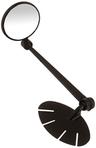
Seven mirrors compared on what their listings actually publish - and the one measurement you have to take yourself, because only two of the five bar-end mirrors here tell you what size handlebar they fit.
Buy the Hafny HF-M956. It is the only bar-end mirror here that publishes the one spec that decides whether it physically fits your bike — handlebar inner diameters from 16 to 24 mm — and it uses real glass, adjusts through 360 degrees and costs less than the Swiss-made alternatives. If you want mirrors on both bar ends, the BriskMore pair is the cheapest honest way to do it and publishes a 14-24 mm fit range.
Before any of that: go and measure the inside of your handlebar end.A bar-end mirror is not clamped to the outside of the bar, it is wedged inside it, and drop bars vary enough that the same mirror fits one bike and rattles in the next. Only two of the five bar-end mirrors on this page publish a fit range at all. Sprintech and CatEye — the two most respected names here — publish none, and CatEye’s listing says only that it “fits both drop and flat handlebars”.
One more thing a mirror page should say out loud. A mirror is optional equipment: it appears nowhere in the statutory list of what a bicycle must or may carry, and it does not replace looking over your shoulder before you move sideways. What it does is remove the need for the other ninety glances — the ones where you just want to know whether anything is back there at all.
How this is funded: we earn a commission if you buy through our links, at no extra cost to you. It never changes which bike we recommend, and we will tell you plainly when we would skip one. Full disclosure.
Quick picks
Ranked on published specs, what the listing does and does not tell you, and who each one actually suits. Select a row to jump to the full write-up. We have not ridden these — here is exactly what we do instead.
#
Bike or gear
Best for
Price
1
Hafny HF-M956-FR06 Drop Bar Mirror
The one bar-end mirror here that publishes the number you actually need: it fits handlebar inner diameters from 16 to 24 mm. Real glass rather than plastic, adjustable through 360 degrees, and it costs less than the Swiss-made alternatives.
Two mirrors in the box and the lowest published weight on the page: Sprintech state under 30 grams each with the plug. The install is a plug swap rather than a clamp, which is why these are the ones that do not drift out of position.
The bigger version of the Sprintech, and Sprintech explain the point of it properly: a larger mirror can use a LESS convex curve and still show the same width of road. Less curve means less distance distortion, which is the real complaint about small bike mirrors.
Aluminum and glass from the brand most riders know for bike computers, with a two-year warranty and the lowest listed weight of any bar-end mirror here. CatEye describe it as nearly distortion-free and as minimal in projection, which is a different trade than the Sprintech XL makes.
Two glass mirrors, a published 50 mm lens, a published 14 to 24 mm bar fitment range and the hex key to fit them, for the least money on this page. It publishes more about itself than the Swiss-made mirrors do.
Nine grams on your sunglasses instead of anything on the bike, and the only mirror here that publishes its mirror dimensions, its reach and its range of adjustment: a frameless 28 x 37 mm mirror on a 70 mm arm that pivots on three axes. It moves with your head, which is the whole argument for and against it.
A long-running helmet mirror on glass rather than plastic, mounted to the helmet shell rather than to your glasses. We are listing it because it answers the helmet-mirror question honestly, and we are telling you up front that its listing publishes almost nothing.
The one bar-end mirror here that publishes the number you actually need: it fits handlebar inner diameters from 16 to 24 mm. Real glass rather than plastic, adjustable through 360 degrees, and it costs less than the Swiss-made alternatives.
Who it is for: A first mirror on a drop-bar road or gravel bike.
What is good
+Publishes the fitment spec almost nobody does — 16 to 24 mm handlebar inner diameter — so you can measure your bar and know before you buy
+HD anti-glare convex glass, explicitly stated as glass and not plastic, which stays clear where plastic hazes
+Adjustable through 360 degrees and usable on either the left or the right side, so it suits either side of the road and either riding habit
+Published lens size of 6 x 5.5 cm and a one-year manufacturer warranty — the only bar-end mirror here that publishes both
+Sold by Hafny directly rather than by a reseller
What you give up
−One mirror, not a pair — the Sprintech and BriskMore sets below give you both sides for less per mirror
−Your bar end has to be open: the listing carries its own capitalized warning to verify this, and a bar with a glued-in plug or tape wrapped over the end needs work before the mirror goes in
−Glass is heavier than polycarbonate, and the listing weight of 0.13 lb is the highest of the single bar-end mirrors here
−A strongly convex lens makes everything behind you look further away than it is, which takes a few rides to calibrate
Skip this if. Skip this if your bars are wrapped with the tape taken over the ends, or if the bar end is plugged rather than open. Fitting it means unwrapping the end of the tape, and that is a job, not a five-minute install.
Published specifications for the Hafny HF-M956-FR06 Drop Bar Mirror
Mounts to
Drop-bar end (inside the bar)
Fits bar inner diameter
16-24 mm (published)
Lens
Convex glass, 6 x 5.5 cm (published)
Adjustment
360 degrees, left or right side
Warranty
1 year manufacturer (published)
Listed weight
0.13 lb as listed (includes packaging)
Specifications read from the retailer listing on October 31, 2026. “Not published” means the listing does not state that figure — we do not estimate it.
#2Best pair for drop bars
Sprintech Drop Bar Mirrors (Pair)
Two mirrors in the box and the lowest published weight on the page: Sprintech state under 30 grams each with the plug. The install is a plug swap rather than a clamp, which is why these are the ones that do not drift out of position.
Who it is for: Running a mirror on both sides, or replacing one that keeps rotating.
What is good
+A pair, so both bar ends get a mirror and the per-mirror price undercuts every single mirror here except the budget sets
+Sprintech publish under 30 grams per mirror including the plug, the lowest manufacturer-published weight on this page
+Published as shatterproof, and the install is a genuine plug replacement — remove the bar end cap, fit Sprintech's cap, insert the mirror — rather than a band clamped around the bar
+Sprintech's own feature list is explicit about the failure mode they designed against: mirrors that rattle and spin out of position
What you give up
−No handlebar inner-diameter range is published anywhere on the listing, so fit on an unusual bar cannot be confirmed before it arrives
−No lens diameter published either, which makes the field of view impossible to compare against the Hafny and BriskMore figures
−Most expensive pair on this page
−Convex, so distances read short — that is true of every mirror here but it is worth saying once
Skip this if. Skip this if you only want one mirror. You are paying for two and you will keep the spare in a drawer; the CatEye or the Hafny is the better single purchase.
Published specifications for the Sprintech Drop Bar Mirrors (Pair)
Mounts to
Drop-bar end (plug replacement)
In the box
2 mirrors (pair)
Published weight
Under 30 g each with plug (manufacturer figure)
Lens
Shatterproof, convex; diameter not published
Fits bar inner diameter
Not published
Listed weight
0.22 lb as listed for the pair (includes packaging)
Specifications read from the retailer listing on October 31, 2026. “Not published” means the listing does not state that figure — we do not estimate it.
#3Best for judging distance
Sprintech Racing XL Drop Bar Mirror
The bigger version of the Sprintech, and Sprintech explain the point of it properly: a larger mirror can use a LESS convex curve and still show the same width of road. Less curve means less distance distortion, which is the real complaint about small bike mirrors.
Who it is for: Judging how far back a car actually is.
What is good
+Sprintech publish the engineering reason rather than a marketing number: the larger size allows a less convex shape for an equally wide field of vision
+Less convex glass is the single biggest improvement available in a bike mirror, because it is distance distortion rather than field of view that makes small mirrors untrustworthy
+Published as an adjustable size that fits a broader range of bars than the standard Sprintech
+Same plug-replacement mount as the pair above, which is the mount that holds its aim
What you give up
−One mirror, and the highest price on this page — you can have the pair of standard Sprintechs for about the same money
−No lens dimension published, so 'extra large' is a relative claim with no number behind it
−No handlebar inner-diameter range published, same as the standard Sprintech
−A bigger housing sticks out further, so it is the most exposed mirror here when the bike falls over or goes through a doorway
Skip this if. Skip this if your bike lives in a narrow hallway or gets racked tightly in a car. The extra width is the whole product, and it is also the thing that gets knocked.
Published specifications for the Sprintech Racing XL Drop Bar Mirror
Mounts to
Drop-bar end (plug replacement)
In the box
1 mirror (single, extra large)
Lens
Larger and less convex than the standard model (published, no dimension)
Fit
Adjustable size, published as suiting a broader range of users
Fits bar inner diameter
Not published
Listed weight
0.15 lb as listed (includes packaging)
Specifications read from the retailer listing on October 31, 2026. “Not published” means the listing does not state that figure — we do not estimate it.
#4Best low-profile bar-end mirror
CatEye BM-45 Bar End Mirror
Aluminum and glass from the brand most riders know for bike computers, with a two-year warranty and the lowest listed weight of any bar-end mirror here. CatEye describe it as nearly distortion-free and as minimal in projection, which is a different trade than the Sprintech XL makes.
Who it is for: A mirror you can forget is on the bike.
What is good
+Two-year manufacturer warranty published on the listing, the longest on this page, and sold by CatEye America rather than a reseller
+Aluminum body with scratch-resistant glass — the only bar-end mirror here that publishes a metal housing
+Published as minimal in projection, so it is the least likely of the bar-end mirrors to catch a door frame or a bike rack
+Published as fitting both drop and flat handlebars, which makes it the one mirror here that moves to a different bike with you
+Lowest listed weight of the bar-end mirrors at 0.08 lb including packaging
What you give up
−No handlebar inner-diameter range published, so measure your bar and be ready to return it
−Nearly distortion-free means a flatter lens, and a flatter lens shows less road — you get accurate distances over a narrower view, the opposite trade to a strongly convex mirror
−No lens dimension published, and the glass is visibly the smallest of the bar-end options
−One mirror only
Skip this if. Skip this if what you want is the widest possible view of the lane behind you. A flatter mirror is a narrower mirror, and the convex Hafny or the Sprintech XL will show you more of the road.
Published specifications for the CatEye BM-45 Bar End Mirror
Mounts to
Bar end — drop or flat bars (published)
Body
Aluminum with scratch-resistant glass (published)
Lens character
Published as nearly distortion-free
Warranty
2 years manufacturer (published)
Fits bar inner diameter
Not published
Listed weight
0.08 lb as listed (includes packaging)
Specifications read from the retailer listing on October 31, 2026. “Not published” means the listing does not state that figure — we do not estimate it.
#5Best budget pair
BriskMore BT-007B Drop Bar Mirrors (Pair)
Two glass mirrors, a published 50 mm lens, a published 14 to 24 mm bar fitment range and the hex key to fit them, for the least money on this page. It publishes more about itself than the Swiss-made mirrors do.
Who it is for: Trying a mirror without committing much to it.
What is good
+Cheapest option here and it is a pair, so the per-mirror price is the lowest on the page by a long way
+Publishes both numbers that matter: a 50 mm convex lens diameter and a 14-24 mm handlebar inner-diameter fit, the widest published fit range here
+HD automotive-grade convex glass with a shatter-proof film, plus a 304 stainless steel fixing screw and an expansion plug
+The 4 mm hex key needed to fit them is included, which the premium mirrors do not mention at all
+360 degrees of rotation and 180 degrees of adjustment, either side
What you give up
−Frame is nylon with 30 percent glass fiber rather than metal — strong for plastic, still plastic
−Heaviest listed weight on the page at 0.31 lb for the pair, though that includes two mirrors and a box
−The lifetime warranty on the listing is a seller promise with no published terms or process behind it, unlike CatEye's and Hafny's stated manufacturer warranties
−A 50 mm convex lens is a small, strongly curved mirror, so distance distortion is at its worst here
Skip this if. Skip this if you are mounting to carbon bars and over-tightening worries you. An expansion plug tightened by feel inside a carbon bar end is the kind of job a torque figure should govern, and none is published.
Published specifications for the BriskMore BT-007B Drop Bar Mirrors (Pair)
Mounts to
Drop-bar end (expansion plug)
In the box
2 mirrors, 4 mm hex key (published)
Fits bar inner diameter
14-24 mm (published)
Lens
50 mm convex glass with shatter-proof film (published)
Frame material
Nylon with 30% glass fiber (published)
Listed weight
0.31 lb as listed for the pair (includes packaging)
Specifications read from the retailer listing on October 31, 2026. “Not published” means the listing does not state that figure — we do not estimate it.
#6Best glasses-mounted mirror
Take A Look Cycling Mirror (Left-Side)
Nine grams on your sunglasses instead of anything on the bike, and the only mirror here that publishes its mirror dimensions, its reach and its range of adjustment: a frameless 28 x 37 mm mirror on a 70 mm arm that pivots on three axes. It moves with your head, which is the whole argument for and against it.
Who it is for: A rider who wears glasses and does not want hardware on the bars.
What is good
+Publishes the full geometry — 28 x 37 mm frameless mirror, 70 mm extension, three axes of pivot — which no bar-end mirror on this page does
+Listed at 0.02 lb including packaging, so on the face it is effectively weightless
+Stainless steel and brass frame with a three-prong clip, published as anti-vibration — the complaint about eyewear mirrors is shake, and this is what they built against it
+Published as made in the USA with a lifetime warranty, and it moves between bikes, helmets and glasses in seconds
+Nothing is attached to the bike, so there is no bar-diameter question and no bar tape to unwrap
What you give up
−It aims where your head aims, so the view behind you changes every time you move — you learn a small head tilt instead of a glance, which takes longer to get used to than a bar mirror
−Shatter-resistant polycarbonate rather than glass, which scratches more easily over years
−This listing is the LEFT-side version only; a right-side version exists as a separate purchase, and that is the one you want if you ride where traffic passes on the left
−Clipping to a bare helmet needs an optional adapter that is not in the box
−A 28 x 37 mm mirror is a small window, and it only works if you are actually wearing glasses or a visor
Skip this if. Skip this if you ride without sunglasses or a visor. Without the optional helmet adapter there is nothing to clip it to, and buying a mirror that needs a second purchase to mount is a bad first mirror.
Published specifications for the Take A Look Cycling Mirror (Left-Side)
Mounts to
Sunglasses, helmet visor, or helmet with optional adapter
Stainless steel and brass, 3-prong clip (published)
Listed weight
0.02 lb as listed (includes packaging)
Specifications read from the retailer listing on October 31, 2026. “Not published” means the listing does not state that figure — we do not estimate it.
#7Best helmet-mounted mirror
Third Eye Pro Helmet Mirror
A long-running helmet mirror on glass rather than plastic, mounted to the helmet shell rather than to your glasses. We are listing it because it answers the helmet-mirror question honestly, and we are telling you up front that its listing publishes almost nothing.
Who it is for: A rider who wants the mirror on the helmet, not on their glasses.
What is good
+Mounts to the helmet itself, so it works whether or not you wear sunglasses — the gap the glasses-clip mirror above leaves open
+Published as shatterproof glass, which is unusual at this price in a head-mounted mirror; the glasses-clip alternative here uses polycarbonate
+Published as adjustable and as an easy mount, and it is the cheapest head-mounted option on this page
+Head-mounted means nothing on the bars: no bar diameter to measure, no bar tape to unwrap, and it moves between bikes with you
What you give up
−The listing publishes exactly one specification — 'Mirror Style: Helmet' — and nothing else: no mirror dimensions, no arm length, no mount mechanism, no weight for the mirror itself
−A head-mounted mirror moves with your head, with the same learning curve as the glasses mirror above
−Warranty is published only as a limited warranty with no duration stated
−Nothing published about which helmets it fits, which for a vented road helmet is the question that decides whether it works at all
Skip this if. Skip this if you want to know what you are buying before it arrives. There is a reasonable mirror behind this listing and almost no published detail in front of it, and a bar-end mirror with a published fit spec is the safer first purchase.
Published specifications for the Third Eye Pro Helmet Mirror
Mounts to
Helmet
Lens
Shatterproof glass (published)
Adjustment
Adjustable (published, no range stated)
Mirror size
Not published
Helmet compatibility
Not published
Listed weight
0.09 lb as listed (includes packaging)
Specifications read from the retailer listing on October 31, 2026. “Not published” means the listing does not state that figure — we do not estimate it.
The measurement that decides this, and how to take it
This is the finding that shaped the page, so it goes before the buying advice. A bar-end mirror mounts by expanding a plug inside the open end of the handlebar. That means the relevant dimension is the bar’s inner diameter, not the 31.8 mm clamp figure you see quoted for stems, and not the 23.8 mm outer diameter of the drops.
Hafny publish 16 to 24 mm. That is the widest useful range anybody states and it covers most aluminum drop bars.
BriskMore publish 14 to 24 mm. Slightly wider at the narrow end, which matters on thicker-walled budget bars.
Sprintech publish nothing.Their mount is a different mechanism — you remove the bar end cap and replace it with Sprintech’s own cap, then insert the mirror into that — so the fit question is about their cap rather than about your bar. It is a neater solution and it is also unverifiable before it arrives.
CatEye publish nothing either, beyond fitting drop and flat bars.
Take the measurement with the cheap end of a vernier caliper, or by pushing a drill bit into the bar end until it stops and reading the shank. If the number comes out below 16 mm, buy the BriskMore. If it comes out above 24 mm — rare, but it happens on some aero and carbon bars — a bar-end mirror is not your answer and you want one of the two head-mounted mirrors further down.
What we compared them on
Criterion
Why it decides the purchase
Published handlebar inner diameter
A bar-end mirror lives inside the bar. If the listing does not publish a fit range, you are guessing, and the guess is a return.
Glass or polycarbonate
Glass stays optically clear for years and shatters; polycarbonate survives impacts and hazes with age. Both are defensible; only one is published on every listing.
How convex the lens is
More curve shows more road and makes cars look further away than they are. Less curve shows less road and tells you the truth about distance.
Single or pair
Per-mirror price swings by a factor of three between the single premium mirrors and the budget pairs. A pair is only better if you will use both.
Bar-end or head-mounted
A bar mirror stays aimed at the road; a glasses or helmet mirror aims where your head aims. That is the real decision on this page, not the brand.
Warranty, and who sells it
CatEye publish two years, Hafny one. Two listings publish a lifetime promise from the seller with no terms behind it. Those are not the same thing.
What is deliberately not on that list: weight. Every weight figure on this page comes from the listing’s own weight field, which includes the packaging — the Sprintech pair lists 0.22 lb for two mirrors and a box while Sprintech’s own feature list claims under 30 grams per mirror with the plug. Those two numbers are not in conflict; they are measuring different things. So the spec tables above label every one of them as a listed weight including packaging, and we do not rank the mirrors on it.
Convex versus flat: the trade nobody explains
Every bike mirror is small, and a small flat mirror shows you almost nothing. So makers curve the glass, which widens the field of view and, unavoidably, makes everything in it look smaller and therefore further away. That is the entire reason riders say they do not trust bike mirrors.
Sprintech are the only brand here who address it directly, and their published reasoning for the XL is the clearest sentence on the subject anyone writes: the larger size “allows for a less convex shape, ensuring an equally wide field of vision”. In other words a bigger mirror does not just show more — it lets them flatten the curve and keep the same width of road, which means distances read closer to true.
CatEye make the opposite call on the BM-45 and publish it as “nearly distortion-free” with “minimal projection”. That is an honest description of a flatter, smaller mirror: accurate distances over a narrower view. Neither approach is wrong, and knowing which one you bought is most of learning to use it.
Want the widest view of the lane behind you?A strongly convex mirror — the Hafny, or the 50 mm BriskMore. Accept that cars read further away than they are for the first week.
Want to judge how far back a car actually is? The Sprintech XL, which is the only product here whose maker explains the physics, or the flatter CatEye.
Want a mirror that is never in the way? The CatEye, published as minimal in projection, or a head-mounted mirror with nothing on the bars at all.
Bar-end or head-mounted: the actual decision
Five of the seven mirrors here go in the handlebar. Two go on your face or your helmet. They are different products that answer the same question, and the choice has almost nothing to do with price.
A bar-end mirror stays aimed at the road. You set it once, and from then on a glance down and left shows the same slice of lane every time. That consistency is why they are easier to learn. The costs are that it only works from one or two hand positions, it is exposed when the bike falls over or goes through a doorway, and it needs your bar end to cooperate.
A head-mounted mirror aims where your head aims.Nothing touches the bike, so there is no fit question, no bar tape to unwrap, and it moves between bikes in seconds. The Take A Look is the only mirror on this page that publishes its full geometry — a frameless 28 x 37 mm mirror on a 70 mm arm that pivots on three axes — and at a listed 0.02 lb you genuinely forget it is there. The cost is real though: the view changes every time you move your head, so instead of a glance you learn a small deliberate tilt, and that takes longer to become automatic than a bar mirror does.
The practical tiebreaker is whether you wear sunglasses on every ride. The Take A Look clips to glasses or a helmet visor, and clipping it to a bare vented helmet needs an optional adapter that is not in the box. If you ride without glasses, the Third Eye Pro mounts to the helmet shell instead — with the caveat that its listing publishes one single specification line and nothing else, which we have said on its card as plainly as we can.
What the law requires, and what it does not
A bicycle’s legal equipment list is short and specific, and a mirror is not on it. Minnesota’s statute is a good example because it enumerates the lot: at night, a white front lamp “visible from a distance of at least 500 feet to the front” and an approved red rear reflector “visible from all distances from 100 feet to 600 feet to the rear”; reflective material including “a minimum of 20 square inches of reflective material on each side of the bicycle or its operator”; a brake that “will enable the operator to make a braked wheel skid on dry, level, clean pavement”; and then a short list of things a bicycle maybe equipped with — flashing lamps, studded tires, and “a horn or bell designed to alert motor vehicles, other bicycles, and pedestrians”.
No mirror, in either list. The federal rule for new bicycles is in the same spirit: it specifies reflectors, not rear vision. The law’s whole answer to what is behind you is to be seen rather than to see — which is worth remembering if you are weighing a mirror against a rear light. If you only have money for one, buy the light. Our bike lights page covers the daytime running lights that do more for your safety than any mirror will.
A mirror is a convenience and an awareness tool, and it is a genuinely good one. It is not a substitute for the shoulder check. The League of American Bicyclists’ published riding guidance is built around positioning and predictability — riding in a straight line, staying out of the door zone, holding your line past parked cars — and all of it assumes you look before you move laterally. A mirror has a blind spot on every bike, it vibrates on rough surfaces, and on a drop bar it shows you a slice of lane rather than the lane. Use it to know whether to turn your head, not instead of turning it. Our road rules and hand signals guide covers the signaling side of the same habit.
How to aim one so it is useful
Sit on the bike in your normal riding position first. Aiming a mirror while standing beside the bike produces a mirror aimed at the sky. Lean against a wall, get your hands where they live, then adjust.
Aim for the lane, not for yourself. A common mistake is setting it so you can see your own shoulder, which wastes most of a small mirror. You want the inside edge of the view just clear of your body, with the rest filled by road.
Pick the hand position you ride most.On the hoods and on the drops give different sight lines to a bar-end mirror. Set it for whichever one you spend the most time in — for most riders on a first drop-bar bike, that is the hoods.
Left side for US roads. Traffic overtakes on your left, so a single mirror goes on the left bar end. Both single mirrors here are usable on either side; the Take A Look listing we feature is specifically the left-side version, and a right-side version exists separately.
Re-check it after the first ride. Everything on a bike moves a little the first time it gets ridden properly, and a mirror that has rotated five degrees is a mirror showing you a hedge.
A note on carbon bars
Two of the mounts here work by expanding a plug inside the bar end. On an aluminum bar that is unremarkable. On a carbon bar it is a clamping force applied inside a thin composite tube by feel, and none of these listings publishes a torque figure for it. If your bars are carbon, the conservative answer is the Sprintech cap-replacement mount or a head-mounted mirror, not an expansion plug tightened until it feels tight. That is the same principle our handlebars guide applies to every bolt that goes near a composite bar.
Which mirror for your setup
Drop-bar road or gravel bike, aluminum bars, one mirror. The Hafny. It publishes the fit range, it is glass, and it is the cheapest mirror here that does both.
You want both bar ends covered for the least money. The BriskMore pair, which also includes the 4 mm hex key you need to fit them.
You want the pair that will not rotate out of aim. The Sprintech pair. The cap-replacement mount is a different and better mechanism than an expansion plug, and Sprintech are explicit that it is what they designed against.
Distance judgement matters more than field of view. The Sprintech XL, for the less convex glass, or the CatEye BM-45 for the flattest lens here in the smallest housing.
Metal housing and the longest warranty. The CatEye BM-45: aluminum, scratch-resistant glass, two years, sold by CatEye themselves.
You always wear sunglasses and want nothing on the bike. The Take A Look, in the left-side version for US roads.
You ride without glasses but wear a helmet. The Third Eye Pro, accepting that almost nothing about it is published.
Your bar ends are taped over and you do not want to re-wrap. Either head-mounted mirror. This is the situation they exist for.
What we would buy
The Hafny, for a first mirror on a first drop-bar bike. It is the only bar-end mirror here that lets you confirm the fit before you spend anything, it is glass rather than plastic, it adjusts through a full circle so you can aim it properly from the hoods, and it publishes a manufacturer warranty. Its honest costs are that it is one mirror rather than two, and that your bar end has to be open.
If you want to spend less, the BriskMore pair publishes more about itself than the premium mirrors do — a 50 mm lens, a 14-24 mm fit, a stainless screw, a hex key in the box — and it is the cheapest option on the page. The frame is nylon rather than metal and the lifetime warranty is a seller promise rather than a documented one, which is exactly what you would expect at the price.
If your bike has drop handlebars and you only want to see the options that mount inside the bar end, the drop-bar mirror roundup narrows this page to four — and explains why a physically larger mirror can use a less convex lens and therefore distort distance less.
And if you are kitting out a bike for riding in traffic for the first time, buy the mirror third. Lights come first, because being seen is what the law and the statistics are both about. A commuting setup that has lights and a lock and no mirror is a sensible bike; one with a mirror and no rear light is not.
We have not ridden these bikes. Every site in this category says it tested twenty of them. We have not tested any, and we say so. What we did instead: read the manufacturer listings and manuals, compiled the published specs, worked out the real out-the-door cost, and checked live availability and price. Here is exactly how that works.
Questions people actually ask
What size handlebar does a bar-end bike mirror fit?+
It depends on your bar's inner diameter, which is the measurement you have to take yourself. Hafny publish a 16-24 mm range and BriskMore publish 14-24 mm; Sprintech and CatEye publish no range at all. Measure inside your bar end with a caliper or a drill bit shank before ordering.
Are bike mirrors required by law?+
No. State bicycle equipment statutes enumerate lamps, reflectors, reflective material, brakes and optional extras like a horn or bell, and a mirror appears in neither the required nor the permitted list. The federal rule for new bicycles specifies reflectors, not rear vision. A mirror is optional equipment.
Do bike mirrors replace looking over your shoulder?+
No, and it is the one thing worth being firm about. Every bike mirror has a blind spot, vibrates on rough surfaces and shows a slice of the lane rather than the lane. Use it to decide whether you need to turn your head, not instead of turning it before you move sideways.
Can you put a mirror on drop handlebars?+
Yes — bar-end mirrors are designed specifically for drop bars and five of the seven picks here are that type. The one condition is that the end of the bar has to be open, so a bar with the tape wrapped over the end or a plug glued in needs fifteen minutes of work before the mirror goes in.
Why do cars look further away in a bike mirror?+
Because the glass is convex. Curving a small mirror is the only way to make it show a useful width of road, and the unavoidable side effect is that everything looks smaller and therefore more distant. A larger mirror can use a flatter curve for the same field of view, which is the published reasoning behind the Sprintech XL on this page.
Is a handlebar mirror or a helmet mirror better?+
A bar mirror stays aimed at the road, which makes it easier to learn and more consistent. A helmet or glasses mirror aims where your head aims, weighs almost nothing, needs no fitment and moves between bikes — but the view changes every time you move, which takes longer to get used to. If you wear sunglasses on every ride, the glasses mirror is worth trying.
Will a bar-end mirror damage carbon handlebars?+
It can, because an expansion plug applies clamping force inside a thin composite tube and none of these listings publishes a torque figure for it. On carbon bars, prefer the cap-replacement Sprintech mount or a head-mounted mirror over an expansion plug tightened by feel.
Should I get one mirror or two?+
One, on the left, for riding on US roads — that is the side traffic overtakes on. A pair is worth it if you also ride somewhere that traffic passes on the right, or if you want a spare, which is a reasonable way to look at the budget pairs on this page given their price.
Do bike mirrors work on rough roads and gravel?+
Less well, and no listing here publishes anything about vibration damping except the Take A Look, which publishes an anti-vibration stainless steel and brass frame with a three-prong clip. On washboard gravel every mirror blurs; a larger, flatter mirror in a rigid mount blurs least.
Sources
Specifications come from the manufacturer or the retailer listing, dated. Where a figure is not published, we say so rather than estimating it.
Minnesota Statutes § 169.222 subd. 6 — Bicycle equipment — Cited for an absence, which is the point our mirror page turns on. This subdivision is a complete enumeration of what a bicycle must and may carry, and it names: at nighttime 'a lamp which emits a white light visible from a distance of at least 500 feet to the front' and 'a red reflector of a type approved by the Department of Public Safety which is visible from all distances from 100 feet to 600 feet to the rear'; reflective surfaces visible from 600 feet including 'reflective materials on each side of each pedal' and 'a minimum of 20 square inches of reflective material on each side of the bicycle or its operator'; permitted flashing front and rear lamps; permitted studded tires; a required brake 'which will enable the operator to make a braked wheel skid on dry, level, clean pavement'; a permitted 'horn or bell designed to alert motor vehicles, other bicycles, and pedestrians of the bicycle's presence'; and a handlebar height limit. A mirror appears nowhere in it, in either the mandatory or the permitted list. The statute's own answer to what is behind you is to be seen rather than to see - which is why our page treats a mirror as optional equipment that does not replace a shoulder check (accessed October 31, 2026)
16 CFR § 1512.16 — Requirements for reflectors — The federal reflector requirement every new bicycle ships with, and what it does not cover (an active light) (accessed August 11, 2026)
League of American Bicyclists — Ride Better Tips — Published riding guidance: ride with the flow of traffic, stay out of the door zone even where that means leaving the bike lane, ride in a straight line past parked cars, cross railroad tracks perpendicular (accessed August 18, 2026)