Road Bike vs Mountain Bike
The two bikes could not be more different, and most first-time buyers are choosing between them for the wrong reason. Where each one actually belongs, and the third option that usually wins.
How this is funded: we earn a commission if you buy through our links, at no extra cost to you. It never changes which bike we recommend, and we will tell you plainly when we would skip one. Full disclosure.
Most people asking this question are not choosing between pavement and singletrack. They are choosing between the two bikes they have heard of. A road bike and a mountain bike sit at opposite ends of everything a bicycle can be, and the honest answer for a first-time buyer is very often that neither one is the right shape for the riding they will actually do.
The difference in nine rows
| Road bike | Mountain bike | |
|---|---|---|
| Built for | Speed and distance on pavement. | Control on trails: rocks, roots, drops. |
| Tires | Narrow and smooth, typically up to 28mm. | Wide and knobbly, usually over 2 inches. |
| Suspension | None. The frame and tires are the suspension. | A suspension fork at least; often rear too. Measured in mm of 'travel'. |
| Handlebars | Drop bars: tops, hoods and drops. | A wide flat bar, one hand position. |
| Riding position | Low and long. | Upright, arms wide. |
| Weight | Lighter, as a rule. | Heavier: suspension, bigger tires, stronger everything. |
| On pavement | Fast and efficient. | Slow and draggy. The tires and suspension fight you. |
| On dirt roads and gravel | Fine on packed surfaces with the widest tire it clears. | Fine, but overbuilt for it. |
| On real trails | No. | This is what it is for. |
What a road bike is for
Covering distance on pavement with the least effort. Trek’s road guide describes the recipe: drop bars, light frames, and “skinny(ish) tires” that “typically come in sizes up to 28mm.” The drop bar gives you the hoods, tops and drops “for more comfort, power, or aerodynamics,” which is the reason a road bike stays comfortable for three hours where a flat bar starts to hurt after one.
The cost of all that is fragility of purpose. A road bike is superb at one thing and merely tolerates everything else. Packed dirt is fine; here is exactly how far it goes. A rocky trail is not.
What a mountain bike is for
Staying in control where the ground is trying to throw you off. The tires are two inches or more wide and covered in knobs; the fork has a spring in it; the handlebar is wide and flat so you can steer with your whole upper body. Trek split the category into cross-country bikes, which “deliver efficient pedaling and quick handling” for smoother trails, and trail bikes, which “make it easier to stay in control in rough terrain” at the cost of weight.
Every one of those features is a penalty on pavement. Knobs squirm, suspension absorbs the effort you put into the pedals, and the upright position is a sail. The mountain bike bought for a road commute is the classic first-bike regret, and it is why the first-bike guide starts with where you will ride rather than which bike looks right.
The question you are actually asking
Nearly everyone who searches this comparison describes their riding the same way: roads, bike paths, some dirt, maybe a trail one day. That is not road-bike riding and it is not mountain-bike riding. Trek’s gravel guide describes the third category as finding “the balance between the off-road capability of a mountain bike and the quick-rolling, lightweight feel of a road bike,” with clearance for 38mm to 56mm tires and a more upright position than a road bike.
That is why this site exists. A gravel bike rides pavement nearly as well as a road bike, rides dirt roads far better, and is the only one of the three you can buy without first deciding what kind of rider you are going to be. The exceptions are real but narrow:
- Buy the road bike if you know the riding is pavement, you want speed and distance, and dirt holds no interest. These are the picks.
- Buy the mountain bike if you have specific trails in mind — rocks, roots, descents — and you will ride them most weeks. We do not cover mountain bikes here; a shop near the trails is the right source.
- Buy the gravel bike for everything in between, which is most people. These are the picks, and gravel bike vs mountain bike explains how much trail it can honestly handle.
What to look for once you have chosen
Whichever way you go, the same three things decide whether a cheap bike is a good one. A named groupset, so a shop can service it. Published frame sizes in centimeters, so you can check the fit. And disc brakes if the bike will see rain or dirt. Below are the three bikes that answer this page’s question for a first-time buyer: the road bike for pavement, the gravel bike for most people, and the flat-bar bike for someone who wanted a mountain bike’s upright position without the trail hardware.
The three answers, with live prices
One bike for each honest answer to the question. All three are registry picks, and every spec on their pages was read from the listing rather than assumed.
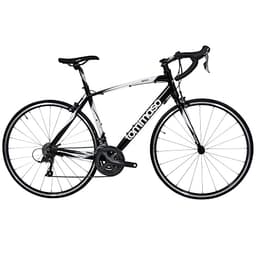
Tommaso Imola
The road bike answer: Shimano Claris, a real size range, and the pavement speed a mountain bike will never give you.
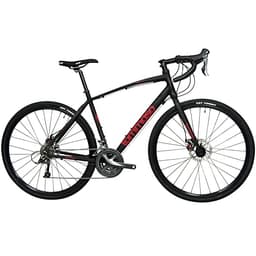
Tommaso Sentiero
The gravel bike answer for most people asking this question: drop bars, disc brakes, and room for tires that handle dirt roads.
$749.99 · View on AmazonPrice as of September 20, 2026. #ad How we’re funded
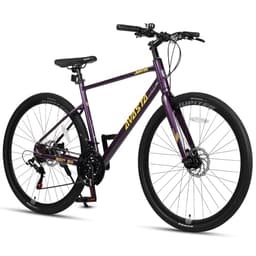
AVASTA 700C Step-Over Hybrid, 19in
The flat-bar answer: a mountain bike's upright position and disc brakes, without the suspension and knobs that make one slow on pavement.
We have not ridden or tested these — every specification comes from the manufacturer or the retailer listing, dated. Here is exactly what we do instead.
The mistake to avoid
Buying the mountain bike “to be safe,” on the theory that a bike built for rocks can obviously handle a road. It can, in the sense that it will not break. It will also be slow, heavy and tiring in a way that has nothing to do with your fitness, and the most likely outcome is that it ends up in the garage. The safe choice for a first bike is the one that is pleasant on the surface you will ride most, and for nearly everyone that surface is pavement with dirt at the edges.
Questions people actually ask
Should a beginner get a road bike or a mountain bike?
Neither, for most beginners - a gravel bike, which Trek describe as balancing 'the off-road capability of a mountain bike and the quick-rolling, lightweight feel of a road bike'. Buy a road bike only if you will ride pavement almost exclusively, and a mountain bike only if you have specific trails in mind and will ride them regularly. If the honest answer is 'roads, paths and a bit of dirt', that is a gravel bike.
Can you ride a mountain bike on the road?
Yes, but it is hard work. Wide knobbly tires drag on pavement, a suspension fork soaks up pedaling effort, and the upright position catches the wind. A mountain bike on a road commute is a reliable way to decide you hate cycling. If you already own one, a pair of smoother tires helps; if you are buying, buy something else for road use.
Is a road bike faster than a mountain bike?
On pavement, by a wide margin, and for the same effort. Narrow smooth tires, no suspension, less weight and a lower position all add up. On a rough trail the mountain bike is faster, because the road bike cannot be ridden there at all.
What is the difference between a mountain bike and a road bike?
Tires, suspension, handlebars and position. A road bike has narrow smooth tires up to about 28mm, no suspension, drop bars and a low position for speed on pavement. A mountain bike has wide knobbly tires, a suspension fork measured in millimeters of travel, a wide flat bar and an upright position for control on trails.
Is a mountain bike good for exercise?
Any bike you actually ride is good for exercise. The catch is that a mountain bike ridden on the road is slow and tiring in an unrewarding way, so people ride it less. For fitness on roads and paths, a road or gravel bike gives you more distance and more enjoyment for the same hour.
Can a road bike go on trails?
Packed dirt roads and rail trails, yes, with the widest tire the frame clears. Rocky, rooted singletrack, no - the narrow tires and rigid fork have nothing to absorb the impacts. Our guide to riding a road bike on gravel covers exactly where the line is.
Sources
Specifications come from the manufacturer or the retailer listing, dated. Where a figure is not published, we say so rather than estimating it.
- Trek — Road bike buyer's guide — Manufacturer statement that traditional road tires typically come in sizes up to 28mm on race-geometry bikes, that endurance-geometry road bikes can clear up to 45mm, and that drop bars give hoods, tops and drops positions for comfort, power or aerodynamics (accessed September 18, 2026)
- Trek — Mountain bike buyer's guide — Manufacturer definitions: suspension is measured in millimeters and the amount is called travel; 29in wheels roll faster and 27.5in are more nimble; cross-country bikes pedal efficiently and suit smoother trails, trail bikes trade weight for control in rough terrain (accessed September 18, 2026)
- Trek — Gravel bike buyer's guide — Manufacturer statement that gravel bikes 'find the balance between the off-road capability of a mountain bike and the quick-rolling, lightweight feel of a road bike', typically clear 38mm to 56mm tires, sit the rider more upright than a road bike, and often carry mounts for cages, racks and bags (accessed September 18, 2026)
- Schwalbe — Tire sizes and the ETRTO designation — How the 40-622 style ETRTO number maps to '700 x 40c' (accessed July 23, 2026)
Read next
Gravel Bike vs Mountain Bike
If trails are part of the plan, this is the comparison that matters.
Read the comparisonGravel Bike vs Road Bike
If they are not, this one is.
Read the comparisonHow to Choose Your First Bike
The whole decision, starting from where you will actually ride.
Read the guideRoad Bike vs Hybrid
The flat-bar alternative for people who want neither drops nor knobs.
Read the comparison