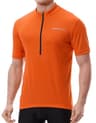
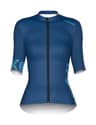
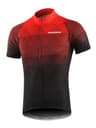
Why the pockets are the entire point
On a drop-bar bike you are leaning forward. Anything in a front trouser pocket digs into your leg on every pedal stroke, and anything in a back trouser pocket you are sitting on.
Cycling jerseys solve this with three open pockets across the lower back — the one place on your body that is horizontal when you ride, is not in contact with the bike, and is easy to reach behind you without stopping.
What goes in them, in the standard arrangement:
- Left pocket: phone, ideally in a plastic bag because sweat gets everywhere.
- Center pocket: the spare tube, tire levers and multi-tool if you are not carrying a saddle bag.
- Right pocket: food, keys, wallet.
That is genuinely it. Everything else about a jersey — the fabric, the fit, the zip — is refinement around the pockets.
Zip length, and when it matters
A full-length zip opens the jersey completely. That sounds trivial and it is the difference between finishing a summer climb comfortable and finishing it cooked — you are working hardest and moving slowest exactly when you most need to dump heat.
Only one listing here confirms a full zip: the Lo.gas. The others do not state it, which usually means a quarter or half zip. For a first jersey in a temperate climate that is fine. If you ride in real summer heat, the full zip is worth choosing for.
Why not just a t-shirt?
You can, and for a 30-minute ride it is completely fine. Three things change on longer rides:
- Cotton holds sweat. A wet cotton shirt is heavy, it chafes at the shoulders and underarms, and it gets genuinely cold the moment you stop or start descending. Every jersey here is a synthetic quick-dry fabric.
- A loose shirt flaps. Above about 15 mph a flapping shirt is slower and noticeably more annoying than it sounds.
- A t-shirt rides up. When you lean forward on drop bars, the back of an untucked shirt lifts and exposes your lower back to sun and cold. Jerseys are cut longer at the back for exactly this reason.
Fit, and the honest word about how it looks
Cycling jerseys are cut close. There are functional reasons — loose fabric flaps, and pockets that swing when loaded are worse than pockets that do not.
There is also an honest thing to say here, since this site is written for people new to the sport: a close-fitting jersey feels exposing the first time you wear one, and quite a lot of people put off buying one because of that. Nobody on the road is looking. If it genuinely bothers you, a “club fit” or “relaxed fit” jersey is cut more generously and still has the pockets, which are the part you are actually buying.
Sizing runs small — often one to two sizes below a US high-street equivalent. Read the manufacturer’s chart every time and do not assume it transfers between brands.
Color, which is a safety feature
Not a style note. Bright colors and high-contrast patterns are meaningfully more visible to drivers than black, and being seen is the main thing standing between you and the most common kind of cycling accident.
White, as on the ROCKBROS, is cooler in direct sun than a dark color and shows chain grease immediately — a real trade-off rather than a preference.
Washing
- Cold wash, no fabric softener. Softener coats the fibers and destroys the wicking, which is the property you paid for.
- Zip it up first. An open zip catches other garments and pulls threads.
- Hang to dry. A tumble dryer degrades the elastane that holds the shape.
Done this way a $20 jersey lasts several seasons, which makes this the cheapest piece of cycling kit per year of use on the whole site.
What we would spend
About $21 on the Spotti, and buy two. Jerseys need washing after every ride, so one is a constraint on how often you ride.
Above about $35 you are buying better fabric, a longer zip and a more considered cut. Worth it once you ride regularly; not the first place to put money on a first setup. If you are choosing between a jersey and padded shorts, buy the shorts first — that is not close either.
Two seasonal notes. In real heat the feature that matters is a full-length zip you can open on a climb, which is why the hot-weather kit page leads on the Lo.gas rather than the Spotti. And if you are shopping women’s-specific kit, this page covers where the women’s label earns its money and where it is a size chart wearing a label.